Neuroscience and cybernetics at the heart of Claudia Vece’s Neuro-Emotional Coaching method at Quantasia
From scouting and model management to Neuro-Emotional Coaching, the leap may seem considerable. Yet for Claudia Vece, it was an almost natural progression—even though there is very little that is conventional about her journey.
Her professional path is proof of this. After beginning her career at a young age in Lugano, gaining experience at the local branch of a Paris-based scouting company, Claudia moved to Paris, where she was offered a management and administrative position at Women Management, one of the world’s leading modelling agencies.
“During my time there, in addition to corporate and personnel management, I was responsible for the complete restructuring of the company, the reorganisation of its teams, a merger and the due diligence processes I led for the sale of the company to an investment fund,” she explains.
“In 2013, under my leadership, Women Management was recognised as the ‘best modelling agency in the world’, thanks to the quality of its model portfolio and the excellent results achieved within just a few years.”
During those intense and rewarding years, Claudia used every available moment to travel and study subjects related to cybernetics and neuro-emotional development—areas that proved particularly valuable in managing the human dimension of organisational change.
“In April 2014, I participated in the corporate restructuring of the group, contributing to the creation of Elite World’s headquarters in Lugano. At that point, I was offered the opportunity to return home.”
Initially, the decision came with some hesitation. After ten years in Paris, returning to Lugano was not necessarily an easy choice. Claudia nevertheless followed her instinct and returned to her hometown. Over time, however, the world of model management began, paradoxically, to feel increasingly limiting.
“After more than ten years in senior positions within international companies, working in celebrity management while simultaneously studying human development and performance in Paris and Barcelona, I decided in 2017 to leave the group and create a project of my own, with the aim of supporting people and organisations through change and transformation. That is how Quantasia was born.”
Quantasia therefore emerged from the convergence of Claudia’s professional experience in organisational and talent management and her interest in multidisciplinary approaches to human development and performance.
“With Quantasia, I developed a multidisciplinary coaching method that brings together the strengths of different disciplines, focusing both on organisational development and on the development of individual potential,” Claudia explains.
Drawing on her knowledge of cybernetics and Neuro-Emotional Education, and specialising in change and the development of complex systems, Claudia created Quantasia with the aim of supporting individuals, teams and organisations throughout processes of transformation and development.
“The focus is on transformation and change from the inside out—from the individual to their personal or professional environment—with the aim of improving performance and results. My approach translates into an experiential and transformative educational practice designed to promote individual and collective awareness and encourage a culture of development within organisations, schools and families.”
But what exactly is meant by Neuro-Emotional Education?
“It is a flexible approach because it incorporates different techniques and methodologies,” Claudia explains.
“It draws inspiration from areas including neuroscience, biology and mind-body research, while integrating cybernetics, Neuro-Linguistic Programming, the Neuro-Emotional Alignment System and mindful coaching.”
To illustrate the concept, Claudia uses a sporting analogy:
“Neuro-Emotional Education is somewhat like athletic training. Just as an athlete prepares both mentally and physically for performance, it helps people develop the awareness and skills needed to approach life’s challenges with greater focus, adaptability and well-being during periods of change.”
What Makes Neuro-Emotional Coaching Different from Traditional Coaching?
“Traditional coaching often provides cognitive strategies designed to address a specific objective,” Claudia explains. “Neuro-Emotional Coaching, on the other hand, also incorporates emotional and body awareness, creating a more integrated approach to change.”
The method is structured around three stages—well-being, empowerment and performance—and aims to help individuals develop new mental, emotional and behavioural patterns through consistent practice.
The concept of neuroplasticity plays an important role in this approach: repeated experiences and behaviours can contribute to strengthening new patterns over time. The objective is therefore to develop skills and responses that can become increasingly accessible when facing pressure, uncertainty or change.
Quantasia has grown to work not only with private clients but also with a range of national and international companies and organisations.
“We work across many different sectors,” Claudia Vece explains, “but we have a particular focus on schools and education, where Neuro-Emotional Coaching can offer valuable tools for developing adaptability, self-awareness and the ability to navigate change.”
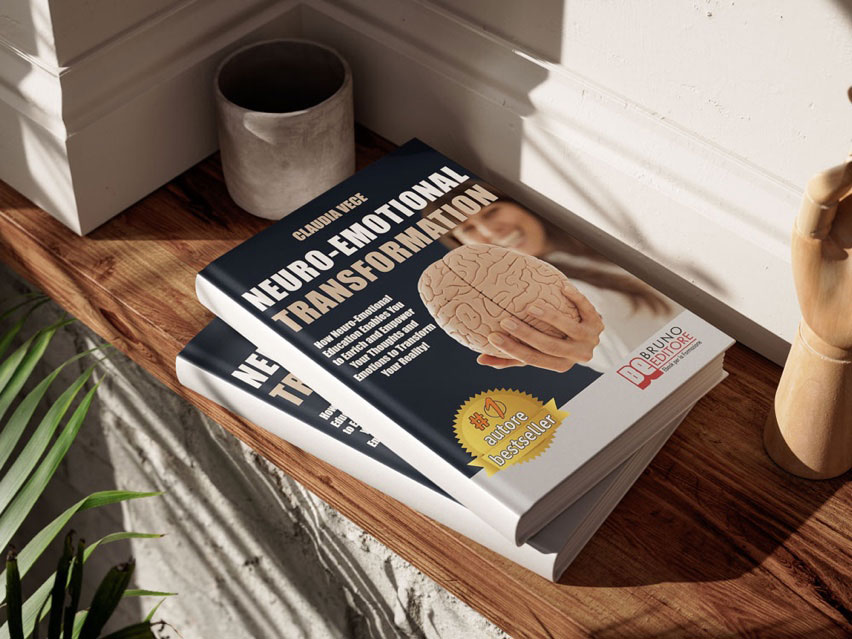
Claudia also has several future projects in development, including the publication of a book.
“I don’t want to reveal too much yet, but it is a book in which I explore my own experience as a starting point for explaining how we can develop our actions and improve our results. Contrary to what one might imagine, it is not an autobiography. Rather, it proposes a model for those who want to explore the path of Neuro-Emotional Education.”
For someone as committed to evolution as Claudia, change truly seems to be a way of life.
Read the original article